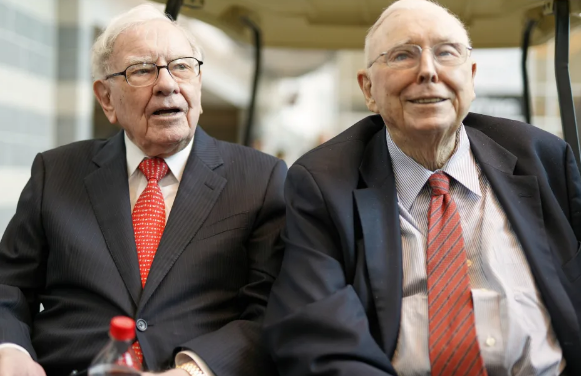
Charles Thomas Munger, had been the esteemed investor and vice chairman of Berkshire Hathaway, and Warren Buffett’s trusted partner for nearly 60 years. Munger, alongside Buffett, was instrumental in transforming Berkshire Hathaway (BRK-A, BRK-B) into an exceptional and enduring corporate alliance, captivating a global audience.
Warren Buffett expressed in a statement, “Without Charlie’s ingenuity, insight, and involvement, Berkshire Hathaway’s evolution to its current prominence would have been unattainable.”
Originating as a textile company, Berkshire Hathaway evolved under their stewardship into a global conglomerate, owning renowned brands such as Dairy Queen and Fruit of the Loom, and holding significant investments in major corporations like Apple (AAPL) and Coca-Cola (KO).
Annually, Berkshire’s shareholders would converge in Omaha, Nebraska, eager to absorb wisdom from Buffett and Munger’s extensive Q&A sessions. Known for his succinct, often profound observations on business and life, Munger’s presence was a highlight, often contentedly sipping Coca-Cola and enjoying See’s Candies peanut brittle alongside Buffett.
Munger’s trademark response, “I have nothing further to add,” post Buffett’s comments, became a familiar refrain.
Born on January 1, 1924, in Omaha, Nebraska, Munger’s formative years were spent in the Dundee neighborhood, mere steps from Buffett’s home. They shared the same high school, and Munger even had a stint at Buffett’s grandfather’s grocery store. Their paths first crossed when they were 35 and 29, respectively, leading to an instant and profound partnership.
Munger, at 17, commenced studies in mathematics at the University of Michigan, only to join the US Army Air Corps at 19 during World War II. His military tenure included studying meteorology at Caltech in Pasadena, California, which eventually became his permanent residence.
Following military service, Munger shifted to legal studies, a path influenced by his father’s legal career and his grandfather’s judicial role. Despite an initial rejection from Harvard Law School, Munger’s persistence paid off, earning him a magna cum laude J.D. degree in 1948. He then embarked on a real estate law career in Los Angeles.
Munger’s return to Omaha in 1959 to settle his father’s estate coincided with a lunch at the Omaha Club, where he met Buffett, marking the beginning of a historic collaboration.
In 1962, Munger established his investment partnership and concurrently launched the law firm Munger Tolles. His focus soon shifted entirely to investment, where he influenced Buffett to transition from ‘cigar-butt’ investing, a Graham-inspired approach of buying undervalued companies for short-term gains, to a strategy of investing in businesses with substantial, enduring profits.
Buffett attributes much of Berkshire’s blueprint to Munger, emphasizing the purchase of outstanding businesses at reasonable prices rather than just cheap companies. Munger’s influence extended to Buffett’s understanding of operating within one’s circle of competence.
Munger’s wisdom also extended beyond business acumen. He often emphasized understanding the boundaries of one’s knowledge and abilities, advising a continuous comparison with other achievers, staying rational, and avoiding self-deception.
Buffett, in his 1985 shareholder letter, highlighted Munger’s inclination to analyze failures rather than successes, aligning with the proverbial wisdom of knowing where you’ll die so you never go there.
Munger advocated for a ‘latticework’ of mental models, stressing the importance of integrating experiences into these models rather than mere rote memorization. His 1994 speech at USC’s business school encapsulated this philosophy, emphasizing the need to continuously learn and apply knowledge.
He coined the term ‘lollapalooza effect,’ representing the convergence of multiple psychological tendencies in a single situation, leading to significant outcomes. Despite no formal training in architecture, Munger pursued it passionately, designing luxury homes, dormitories, and even his residence.
A life filled with personal challenges, including the loss of a child, a failed marriage, and health setbacks, Munger’s resilience and intellect never wavered. His second marriage to Nancy Barry spanned 54 years until her passing in 2010. When asked about relationship longevity, Munger attributed it to being deserving of a good spouse.
Munger’s recipe for a fulfilling life was straightforward yet profound—eschewing envy and resentment, living within means, maintaining cheerfulness despite difficulties, associating with trustworthy people, and fulfilling responsibilities.
His legacy extends beyond his business triumphs, leaving an indelible mark on the realms of investing, wisdom, and human character.